



By Michael Ovat -Awka
The Small-Scale Women Farmers Organization in Nigeria (SWOFON), has called on governor Chukwuma Charles Soludo to make Agricultural Budgets Work for Small holder Women Farmers in Anambra State.
They also called for stronger and more accountable public investment in agriculture in the State with particular attention to the priorities of small holder women farmers who contribute significantly to food production, rural livelihoods and local economic activity.
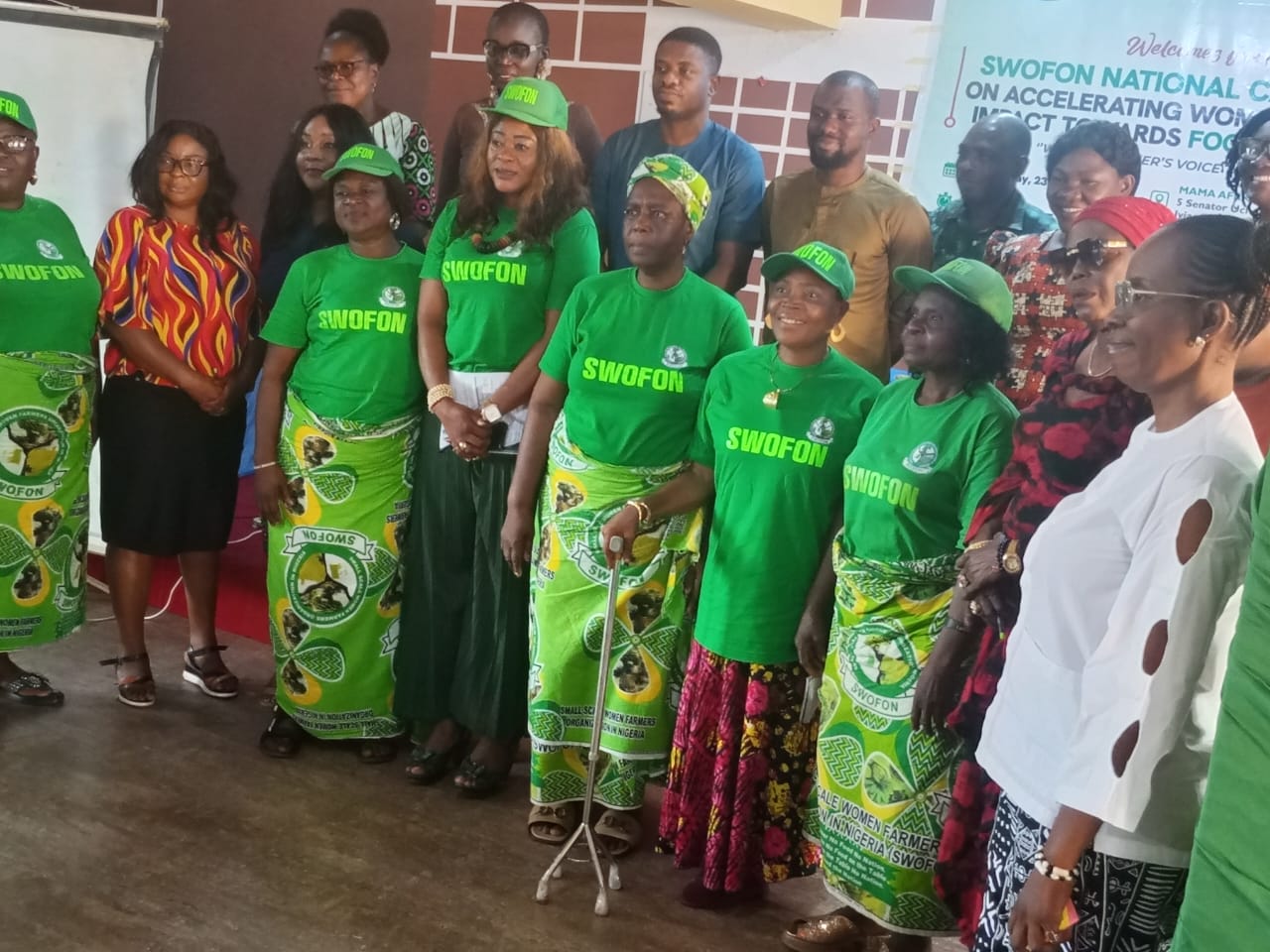
The made the called during SWOFON’s national campaign themed “Women Farmers: Voice to Action”.held in Awka on Wednesday, September 23rd, 2026.
The Newsletter gathered that the call follows findings from the IBP–SWOFON Impact Assessment, 2019–2025, which examined SWOFON’s contribution to budget advocacy, access to productive resources, institutional strengthening and women farmer empowerment across five focal states, including Anambra.
The assessment provides an important message for Anambra State: women farmers are increasingly participating in public budgeting and policy processes, but participation must now translate into identifiable budget commitments, implementation and tangible services at community level.
“Agricultural investment remains a critical concern.
According to the group assessment, Anambra State allocated 2.03% of its approved state budget to agriculture in 2021, 1.90% in 2022, 0.97% in 2023, 0.68% in 2024 and 0.59% in 2025.
The assessment uses the African Union’s Maputo/Malabo 10% agricultural expenditure commitment as an advocacy benchmark. On that basis, Anambra’s 2025 agricultural allocation represented a substantial gap from the benchmark, estimated in the assessment at ₦57.12 billion. The report cautions that differences in state budget classifications mean such comparisons should be interpreted as indicative rather than as definitive measures of compliance.
“The challenge is not only the amount approved. It is also whether approved resources are actually converted into agricultural services, infrastructure, productive assets and opportunities for farmers.
“Between 2021 and 2025, Anambra recorded ₦10.97 billion in approved agricultural capital expenditure and ₦3.21 billion in reported actual spending, an execution rate of 29.3%. This means that the majority of approved agricultural capital expenditure was not recorded as spent during the period assessed.
“A budget allocation that does not reach implementation cannot fully address the practical constraints farmers face, including access to productive equipment, inputs, extension services, finance, land, irrigation, storage, processing and markets.
“From a Charter of Demands to a traceable budget commitment
SWOFON’s Charter of Demands was developed through consultation with women farmers and presented to relevant government institutions during budget and legislative engagement processes.
“Here in Anambra, the Charter was submitted and acknowledged, demonstrating that women farmers have established a pathway for participation in state-level policy and budget discussions.
However, the assessment found no traceable Anambra State appropriation line linked directly to the Charter of Demands. The report further notes that some support received by Anambra women farmers came through federal programmes rather than through a clearly identifiable state budget response to SWOFON’s Charter.
“This distinction is important.
SWOFON recognises and welcomes agricultural support reaching women farmers through government programmes. However, sustainable public accountability requires that women farmers should be able to identify what has been budgeted, where it is located in the budget, how much has been allocated, which institution is responsible, when implementation should occur, and who is expected to benefit.
“The assessment therefore points to the need to move from acknowledgement of demands to traceable commitments and beneficiary-verified delivery.
“The assessment also documents examples of agricultural support reaching women farmers in Anambra.
“In May 2025, SWOFON members in Anambra East LGA participated in training on agricultural product packaging and value addition. The assessment records a proposed ₦3 million financing package, structured as 30% grant and 70% interest-free loan, with a training-of-trainers approach intended to extend knowledge to other LGAs.
“In January 2026, following the formal 2019–2025 assessment period, the Federal Ministry of Agriculture and Food Security distributed new knapsack sprayers to more than 50 farmer groups and cooperative societies across Anambra State. The assessment explicitly treats this as supplementary evidence of continued agricultural support rather than as an outcome achieved during the assessed intervention period. SWOFON’s Anambra Coordinator indicated that the equipment would be shared among SWOFON members across the state’s 21 Local Government Areas.
“SWOFON calls on the Anambra State Government, relevant Ministries, Departments and Agencies, the State Legislature, Local Government Councils and other stakeholders to work with women farmers to strengthen this transition.
Speaking further, the Anambra State coordinator of SWOFON, Mrs Georgina Akunyiba, recommended that the Association proposes five practical actions:
“Institutionalise women farmers’ participation in the budget cycle.
Create a predictable mechanism for SWOFON and other organised women farmer groups to participate in agricultural budget formulation, review and monitoring at both state and Local Government levels.
“Convert priority demands into costed budget lines.
“Improve agricultural budget execution and transparency, Strengthen access to productive resources and the establishment of beneficiary-level accountability, where women farmers should be able to participate in monitoring whether approved agricultural projects and services actually reach intended communities.
“SWOFON remains committed to constructive engagement with the Anambra State Government and other relevant stakeholders to strengthen gender-responsive agricultural budgeting, improve accountability and ensure that women’s priorities are reflected not only in consultations, but in budgets, programmes, implementation and results.
In her goodwill message, the Country Director of the International Budget Partnership (IBP) Nigeria, Dr Yinka Babalola, also appeal to government at all level to support women farmers to enable them sustain food security and availability,
She noted that majority of what feeds the nation passes through women’s hands and yet, for too long, decisions about the budgets meant to support that work were made without them in the room.
Babalola commended the governor Chukwuma Charles Soludo for making Agriculture one of the major priority of his administration.
Also present during the event, include; representative of the Permanent Secretary, State Ministry of Budget and Economic Planning, Mrs Chinyere Nwabachili, the Head of Department, Partnership Coordination, Mrs Obianamma Orji, Head of Agriculture and Natural Resources, Nnewi North, Mr Cajetan Ajanobi, the State Manager of the Small and Medium Enterprises Development Agency of Nigeria (SMEDAN), Mrs Chito Onuzulike and
Chika Orji of the SWOFON National Secretariat Abuja.
