



By Michael Ovat- Awka
A Professor of Law at the Chukwuemeka Odumegwu Ojukwu University, Anambra State, Prof Charity Ifenyinwa Emielie, has called for an inclusion of ECOCIDE as 5th International crime against humanity.
She also called on President Bola Ahmed Tinubu’s led-Federal government to urgently include it into Nigeria law as so as possible to curb the challenging environmental harm in the country, especially, in the Niger Delta region, where those found guilty of environmental abuse can be arrested and presecuted.
Emielie, who made this known at the institution’s 35th inaugural lecture series, held at ETF Auditorium, Igbariam campus, on September 24th, 2024, titled, ‘Environmental Abuse/Harm: A case for the International Criminalization of ECOCIDE, identified political, socio-economic disparities and environmental mismanagement as a major development challenge confronting Nigeria as a nation.
ECOCIDE is a mass damage, destruction, or loss of ecosystems and the natural environment, whether caused by human activities, industrial disasters, or war. It is also a damage that is irreversible or cannot be repaired through natural recovery within a reasonable period, an acts done with reckless involving a very serious adverse changes, disruption, or harm to the environment.
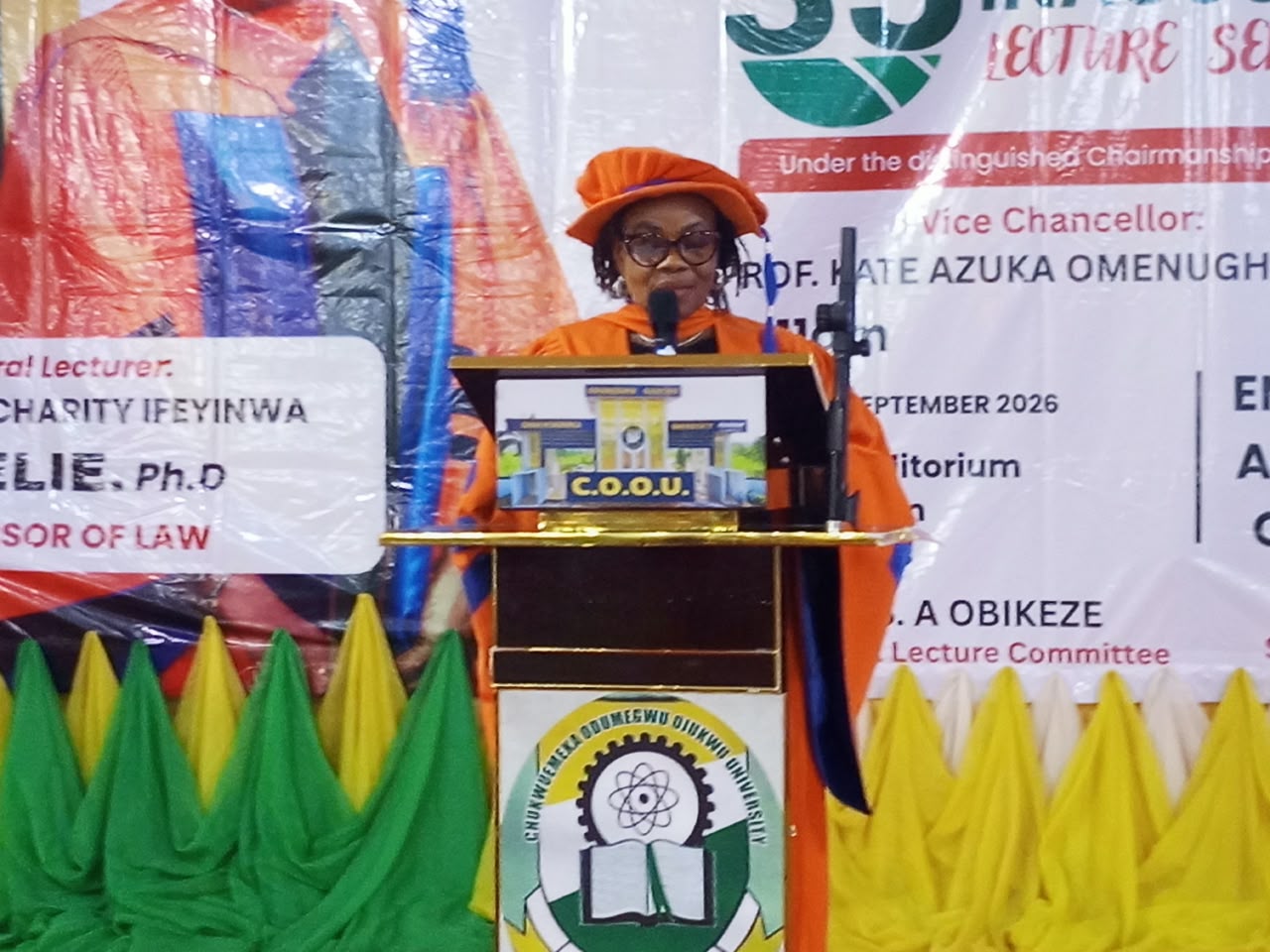
Speaking further, Prof Emielie advocated that recognising ECOCIDE as a fifth international crime against humanity would redirect the World, particularly, Nigerian’s attitude towards maintaining and sustaining a clean, friendly and healthy environment.
She said the recognition of ecocide is not merely a legal innovation but a moral inheritance owed to future generations.
According to her, there is need for us to checkmate our environmental protection, pollution and abuses because environmental protection has no boundary.
‘”The destruction of environment is so serious in Nigeria, especially, in the Niger Delta region by the oil and gas companies.
“Ecocide is not yet an International Crime; however, some Countries have recognised this crime against destruction of the natural environment as a crime that needs to be included as a global crime.
“The globally recognised four main categories of international crime are Genocide, Crime against humanity, War Crimes and the Crime of Aggression and if all this are listed as world crime against humanity, why is it that ECOCIDE that has direct impact on human values should not be included as the 5th International crime against humanity?.
“In 1995, Ken Saro-Wiwa stood before a military tribunal in this very Nation. His crime, according to the State, was incitement. His actual crime, in the eyes of history, was to name what was happening in Ogoniland: the slow assassination of a people through their environment. He called it “ecological war.” Thirty-one years later, the gas flares still burn in Rivers State. The creeks still carry the iridescent sheen of crude. The life expectancy in parts of the Niger Delta remains 10 years below the national average.
“We have words for what happened to Saro-Wiwa. We call it a miscarriage of justice, a crime against humanity, a political murder. But we still lack a word in international criminal law for what happened and is happening to the land itself.
“The central thesis is that ecocide constitutes a crime against the conditions of human flourishing and must be recognized as such in international law.
“International crimes are acts that occur across national boundaries that violate international law and are typically prosecuted by the international Courts or Tribunals.
“They are extremely serious violations of international law, affecting the entire international Community. The globally recognised four main categories of international crime are Genocide, Crime against humanity, War Crimes and the Crime of Aggression.
“The history of International Crime is traced from early notion of Piracy and Slavery, emanating from Hague Conventions and the post-world war II Nuremberg and Tokyo Tribunals. This narrative was later to find expression in the Rome Statute adopted on 17 July 1998.
“Ecocide being proposed as one of the International Crimes is the destruction of the natural environment, especially when it is deliberate. It is also the destruction of the natural environment by deliberate or negligent human action.
“The main focus of this 35th Inaugural lecture series of this great University of “Now and of the Future”is to proffer sufficient grounds in support of the growing movements to add Ecocide as the “fifth international crime” to the Rome Statute.
“Environmental pollution is not new. It is as old as human civilization. However, its scale, complexity, source, impact and legal treatment have evolved dramatically.
“It has changed with human activity and technology. From localised smoke from firewood to global climate-altering emissions, pollution has moved through distinct historical phases.
“The origin of pollution has been traced to 4 global eras and then narrowed to Niger Delta in Nigeria as a case study. The goal is to show that the current crisis is not accidental, but the product of 200 years of industrial logic meeting weak governance.
“This historical foundation is necessary to justify why civil and regulatory law have failed, and why criminalization through “ecocide” is now proposed.
“Section 33 of the 1999 Constitution guarantees the right of every Nigeria to life. It recognises the fundamental rights of the citizenry to a clean and healthy environment to sustain life. Thus environmental harm that threatens health or livelihood should ordinarily constitute a breach of the right to life under the above mentioned section of the Constitution.
“To that extent, Prof Emielie suggested the following to Nigeria government:
“To Insert a justiciable right provision to a clean and healthy environment into Chapter IV of the Constitution, as was done by South Africa in 1996 and Kenya in 2010.
” Establish Specialised Environmental dedicated Courts with technical assessors, as done in India and Kenya, to handle oil spill, EIA, industrial waste, deforestation, and climate cases expeditiously,
“The National Assembly should enact a framework law that operationalizes section 20 and gives citizens locus without proof of special damage,.
“The Petroleum Industry Act (PIA) and the National Environmental Standards and Regulations Enforcement Agency Act should be strengthened to impose strict liability and mandate community environmental trusts.
“Legal Aid should be expanded and law clinics encouraged to take up environmental matters pro bono.
Emielie also urged universities in Nigeria to move beyond knowledge generation to becoming drivers of transformative change, stressing that sustainable environmental development requires collaboration among scientists, policymakers and local communities
In her brief remark via visual, the University’s Vice-Chancellor, Prof Kate Azuka Omenugha, while commending the success of the Inaugural lecture, promised to support the advocacy for a better society.
